


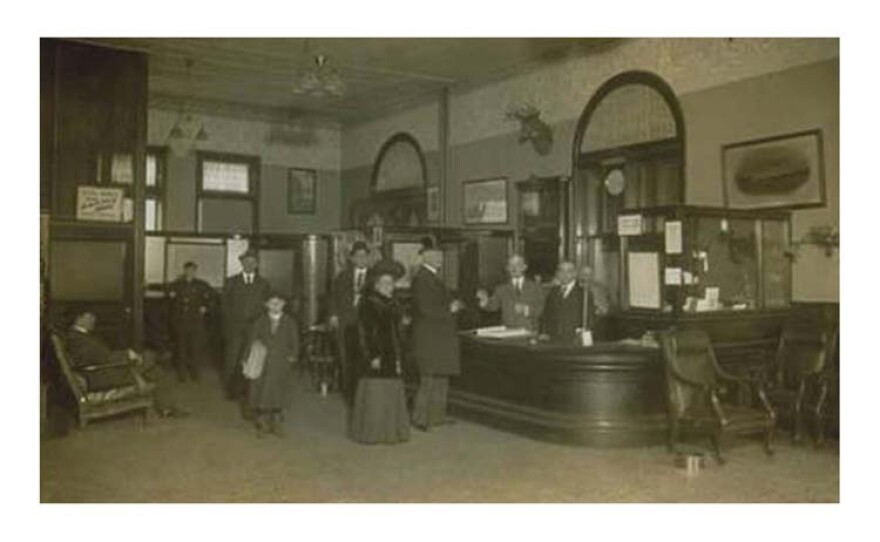
In an age when we hear instantly of any news, good or bad, it is hard to imagine that information was not always so readily available. On May 7, 1915, the RMS Lusitania sank off the coast of Ireland from damage caused by a German submarine’s torpedo. For hours, it was little more than an unconfirmed rumor that the ship had sunk, and many accounts incorrectly reported the ship was beached with no loss of life. Approximately an hour and a half after the sinking, a cablegram to the New York City office of the Cunard Line, the steamship line that owned and operated the Lusitania, confirmed the sinking. The Cunard office did not release information about the disaster until nearly four hours after the event. Almost twelve hours after the ship sank, the Cunard office learned that lives had, in fact, been lost.
In Hartford, the telephones at The Hartford Courant office rang constantly once news of the sinking reached the city in the middle of the afternoon. Calls poured in until midnight from individuals trying to find out information about the incident. As The Hartford Courant received information bulletins, they posted them on outdoor boards for the benefit of the crowds that gathered to get the latest news. Throughout the day, offices in downtown Hartford sent office boys to the boards to gather what information they could.
Hotels, cafes, and clubs equipped with a machine that printed ticker tape with information received from a typewriter-like machine on the end of a telegraph wire, also provided updated information. Additionally, the city buses spread the news as passengers passed on new information to the drivers who then helped convey it to other parts of town.
Back in New York City, the Cunard office continued to receive official reports. Lists of both survivors and casualties were read aloud to the gathering crowds. Some people even tried to profit from the disaster by offering information about passengers for a fee. The Cunard office, however, made it clear that they would provide any and all information they received without cost and that relatives and friends of those on board would be notified as the office learned news of their loved ones.
It is hard for us to imagine a time when it took hours to learn the most basic details of a disaster. In earlier times, however, before the telegraph and telephone, it could take weeks or even months to learn news of distant disasters. To learn more about the history of communications in Connecticut, visit the Research Center at the Connecticut Historical Society, located at One Elizabeth Street, Hartford, CT. The Research Center is open Thursday 12-5 and Friday-Saturday 9-5. For more information, go to www.chs.org.



