

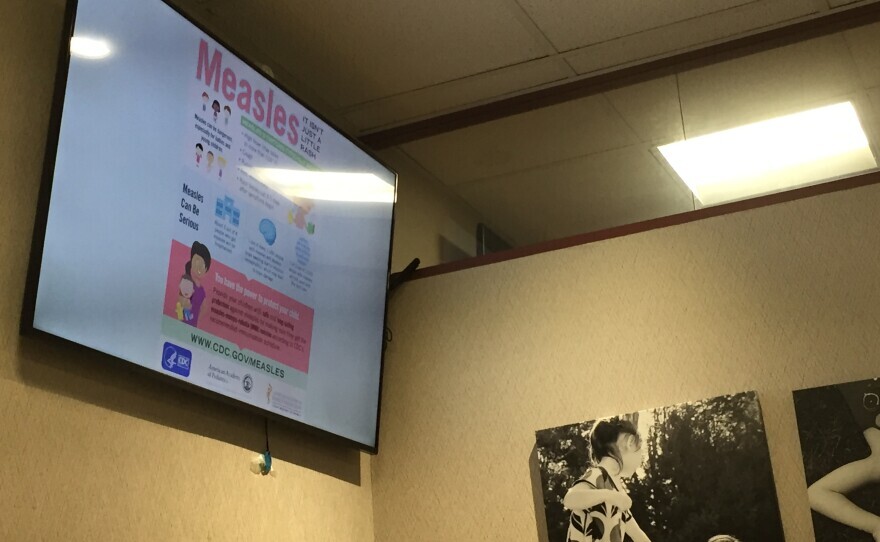
Western Massachusetts health providers are getting their own word out on vaccines to counter what they say are dangerous new recommendations from the U.S. Centers for Disease Control.
U.S. Health Secretary Robert F. Kennedy Jr. has long been a critic of vaccines, and in early January, the Trump administration changed the CDC’s schedule for childhood vaccines – in part due to a long-disproven connection between vaccines and autism. The new federal guidelines reduce the number of recommended vaccines for children from 17 to 11, and restrict or delay others.
“It's very confusing to the public and is unnecessary,” said Dr. John Snyder with Amherst Pediatrics, “and it will result in unnecessary illness and death in children, which is tragic.”
Amherst Pediatrics recently sent a message to all patients’ families that the practice is still following the previous science-based guidelines, supported by the American Academy of Pediatrics.
While they won’t kick out current families who insist on following the Trump administration’s guidelines, Snyder said, they will not accept new families who do.
The practice has also made clear in messages and on its website “that the CDC is unfortunately no longer a reliable source of information on anything that is related to public health,” Snyder said. “It’s unbelievable that we have to say that and that that's reality. But they have lost all credibility because of the decisions they’re making.”
That’s why Snyder and other providers have launched a new website – ValleyVax.org – which they say focuses on science-based vaccine information, in contrast to what’s now on the CDC website.
Amherst public health director Kiko Malin, who is spearheading the effort, said they chose to offer a local resource rather than just link to national organizations.
“We wanted something that looked like the Pioneer Valley that felt familiar and appealing to build this bridge and help people to get information from people who feel familiar and that they might be more likely to trust,” Malin said.
She said people can also ask questions through the website, including about vaccine safety.
Malin said she has assigned some of her staff to work on the website but it is not an official town resource. And while ValleyVax includes links to organizations that strongly disagree with the new federal vaccine guidelines, she said they chose not to include overt political statements on the website.
“Some information from the CDC is reasonable, like they are doing a good job of tracking influenza-like illness rates in the country,” Malin said. “So I think it's important not to discount (the CDC) completely. But when it comes to vaccinations, it is a bit tricky. I think as a group, we hadn't asked that question about whether we want to put that (criticism) on the website. It may come later, but it's right now it's just a carefully curated set of resources.”
Massachusetts Gov. Maura Healy has said the state does not accept the CDC’s change in vaccine schedule and the state Department of Public Health continues to recommend the previous guidelines.
“The decision to change CDC’s childhood immunization schedule is reckless and deeply dangerous,” said Massachusetts Public Health Commissioner Robbie Goldstein, in a statement. “It replaces decades of transparent, evidence-based guidance with uncertainty. At a time when we are seeing measles outbreaks across the country, a resurgence of whooping cough, and a severe respiratory virus season – including pediatric deaths from diseases that are preventable – this action puts families in an impossible position and places children and communities at risk.”



