Puedes leer esta historia en español aquí.
Kindergartner Josephine Ziniti sat at her teacher’s feet, hand held high, eager to answer a math question. And when her teacher, Jacqueline Gleason-Boure, moved to the floor, Josephine and her classmates closed in around her, eager to get her attention.
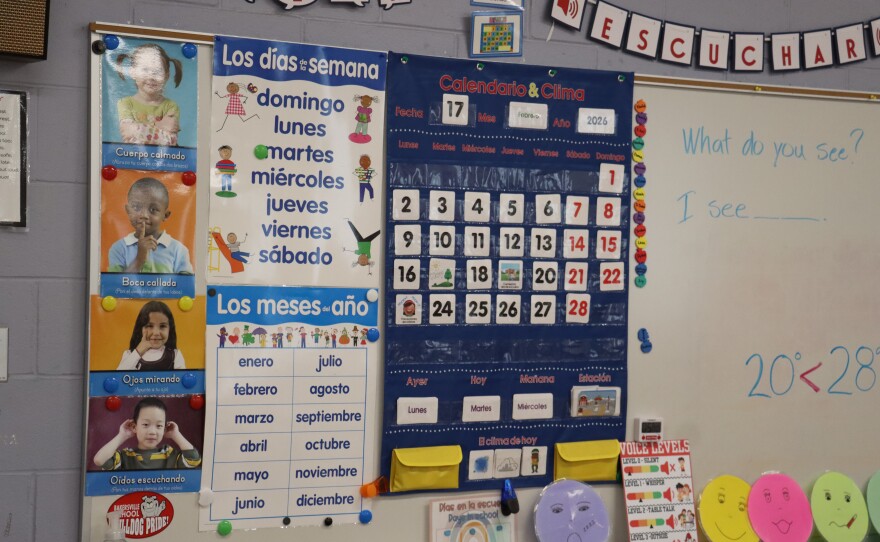
Josephine’s classroom at Manchester’s Weston Elementary School looks like any other: clusters of tiny desks, a brightly colored rug, Crayola markers, and vocabulary words on the wall.
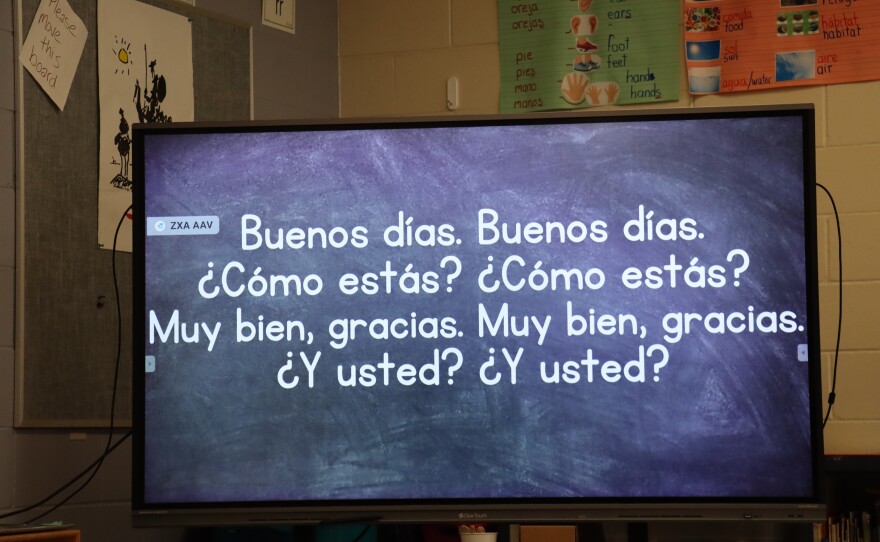
But it doesn’t sound like one. In here, Josephine learns her core subjects - from math and science to reading and spelling - in French.
“We’ve learned every letter in the alphabet,” Josephine said before reciting them.
New Hampshire’s public schools must offer foreign language courses, but most schools begin those classes in middle or high school.
What really sets Manchester’s dual language program apart, though, is its immersive approach. Beginning in kindergarten, students get 30 minutes of instruction in English a day, and — aside from lunch, recess, and classes like gym — they spend the rest of the day learning and speaking in Spanish or French.
Nearly 45 states offer these immersive programs, but the Manchester School District appears to be the only one doing it in New Hampshire. The program is optional for Manchester families. Nearly 70 students are enrolled in Spanish classes, which began last year, and ten are in the French program that started this year.
This week, the district will begin enrolling new kindergarten classes in both languages. The two languages the district has chosen make sense. Spanish is the second-most spoken language in the city’s schools, and Manchester has a long heritage of French Canadian speakers.
Beneficial in ‘so many ways’
Families have opted in for a variety of reasons.
Josephine’s mother, Beth Ziniti, said it feels like “a dream” to have this opportunity in her local public school. She studied French linguistics in college and lived in France for two years. Ziniti wanted to expose Josephine to a second language early.
“I saw it as an alternative way of looking at the world,” Ziniti said. “It kind of trains you to be maybe empathetic to differences in the world and just more understanding. I just saw it as an excellent learning opportunity."
Parent Hannah Neidorf has always been envious that her sister is fluent in Spanish and lives abroad.
“She's had many really interesting life experiences that I never will because I don't speak a second language,” Neidorf said. That’s one reason she enrolled her son Elijah in the Spanish program last year.
Elijah, now a first grader, had a different agenda. He wanted to play with his Spanish-speaking neighbors.
“Two of them don't know English that well, and the youngest one barely only knows a single word in English,” Elijah said. But he can tell they understand more English than they can say. And talking with them in Spanish has been good practice for class.
Heather Kezer’s daughter Ivy is in a kindergarten Spanish class. Kezer plans to enroll her son next year.
“I definitely can see as an adult now how beneficial it is in the workforce,” Kezer said. “When she goes to college or she wants to travel, having that second language, especially Spanish, I think will be so beneficial to her in so many ways, give her more opportunities.”
Hashira Rodriguez enrolled her son in the Spanish program for similar reasons, and also so he could stay connected to family.
“His great grandmother only speaks Spanish, so being able to communicate with them more has been huge,” Rodriguez said. “They think it's so special that he goes out of his way to greet them and talk to them in Spanish. It just means a lot, and I think it's really important to not lose our culture as well.”

On par academically
About half of the students in each classroom come from Spanish or French speaking homes or have a cultural connection to those languages.
The district phases in more English each year. By fourth grade, it’s an even split between English and Spanish or French. After sixth grade, when the program ends, students will move to traditional English-speaking classes.
Wendy Nassar Perron leads the district's multilingual learning program.
She said studies have shown that multi-lingual students can more easily switch between tasks as well as use logic to make decisions and solve complex problems.
“Our teachers use…specific teaching strategies to help them transfer what they're learning in one language to the other, which is where you see the magic around the translanguaging,” Nassar Perron said.
Academic assessments, which track literacy and progress on all core subjects, show the students are on par with their peers. Studies indicate they may outperform their peers by fourth grade, when students are learning equally in English and Spanish.

Trying is celebrated
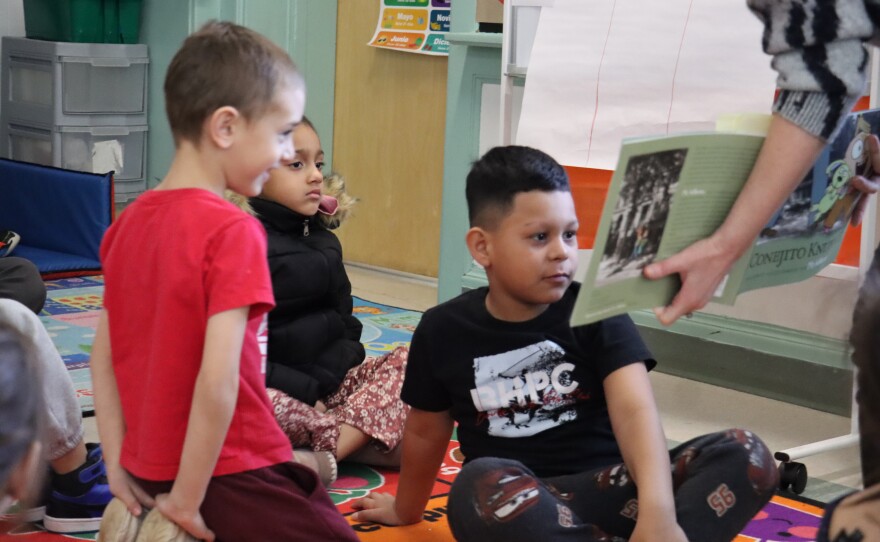
One morning in Elijah’s classroom, teacher Emery Griffin stood at the front, reading a picture book about a girl named Trixie and her journey along an emotional rollercoaster. Griffin’s students sat at her feet on a brightly colored rug, with words like seal, butterfly and shark translated into English and Spanish.
As Griffin turned the pages, they moved closer to see the pictures. They were transfixed, acting out each emotion. When Trixie cried, they cried. When Trixie was angry, they were too.
They were no less animated when Griffin moved to grammar lessons.
When a student slipped into English, Griffin replied in Spanish, and it was clear the students could follow along. The whole class celebrated when a classmate answered one question in a quiet hesitant voice.
“Armani, lo intentaste,” Griffin said and then translated her words. “You tried it, that’s what matters. You did awesome.”
The school district will add new Spanish and French kindergarten classes each year as this year’s students move into the next grade. Enrollment opens this week.