


http://cptv.vo.llnwd.net/o2/ypmwebcontent/Chion/ss%20120117%20sb%20decd%20loans.mp3
Last year’s jobs bill set aside $100 million as a loan pool to help small businesses grow and create jobs. It’s dubbed the Small Business Express Package, and applicants were promised a quick turnaround. State officials have been touring the state to explain the program to businesses that might benefit. But as WNPR’s Sujata Srinivasan reports, they have yet to finalize a loan.
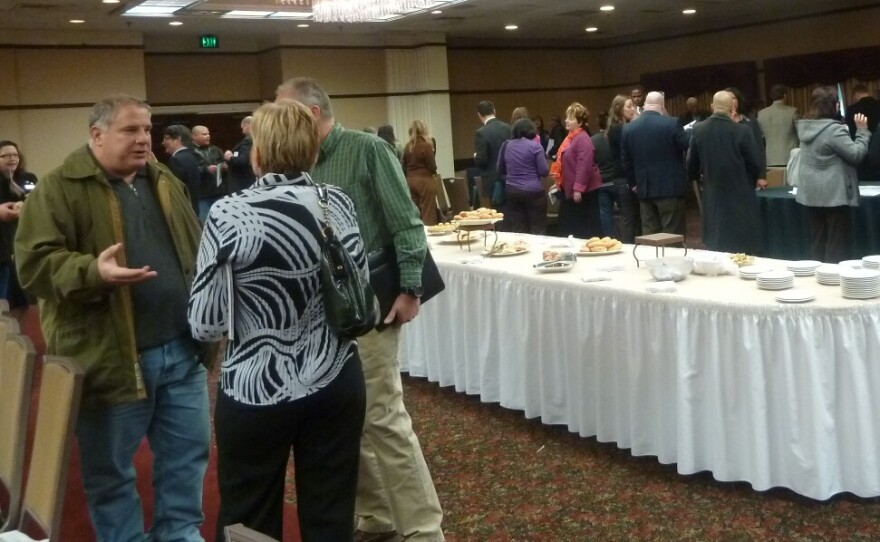
It’s a crisp January morning in Meriden where nearly a hundred entrepreneurs are at a Department of Economic and Community Development breakfast event. Everybody is hoping to get a share in the cash allocated for small business loans under the jobs bill, passed by state lawmakers last October. Edward Heath is an inventor based in North Madison, who has created energy-saving concepts that require funding to move on to the product stage. He is hoping to get around $600,000 from the state to build working prototypes.
"The banks, because this type of technology is not proven, they will not even look into this. So I have to go in for private equity type of funding or hopefully the state will help."
In addition to loan programs for start-ups, entrepreneurs are seeking funding to fulfill working capital requirements, hire more employees, or expand an existing business. Andrew Ladyga is the owner of two used car dealerships, which were funded by bank loans and private investments. He is now applying for a low-interest loan from the DECD to open a third dealership. Under the Express Package – which is typically designed for businesses with less than 50 employees – interest rates are as low as 0 to 4%.
"I’m probably going to be in the ballpark of about a half a million. I think it’s going to be a good start to get up and running and to be able to cover the inventory that I’m going to need, the building expenses and the construction costs associated with getting this up and running to a proper way of doing the business."
Some participants like Melina Erwin, a business advisor at the University of Hartford Entrepreneurial Center, are at the event on behalf of their clients. Erwin advises women-owned small businesses on how to diversify and increase revenue through exports.
"There’s a president’s export initiative to increase U.S. exports over the next five years because it’s proven that exports are key to job creation. Export jobs have a multiplier effect in the economy and I’m very interested in what the state of Connecticut has in store for companies that are trying to export."
Commissioner Catherine Smith says the DECD has hosted several sessions, reaching nearly 1,000 individuals since the bill was passed. As of last week, the DECD had 170 applications in process – but is yet to advance its first loan. The department has seven official non-profit partner agencies that will help businesses choose the right program, prepare the paperwork and administer the loan funds. But several of these agencies – who declined to be interviewed – told WNPR they are waiting to sign contracts with the DECD so they can start issuing loans. Smith attributes the delay to uncertainty on the part of state attorneys on whether the organizations are authorized to make the loans.
"If it requires legislation or correctional legislation, then we’ll take it into the legislative session on February 8th. If not, if it’s a matter of interpretation, then we hope to get that resolved in a matter of days."
The DECD loans and grants will be funded by long-term bond money. Smith says the investments will expand the state’s corporate tax base, thereby increasing revenue in the long run. She says because the DECD acts as a lender of last resort, the approval process for loans and the risk threshold is lower than that of the private sector – but she is quick to add that the benefits will exceed the costs.
"We want to make sure we’re credible in the way we’re underwriting the loans, for example. But we may not be quite as stringent as a local bank. Now I will tell you that because we will be lending to small businesses, not every single business will survive and some people will have trouble. But I think we are playing the odds here and most of the businesses will do very well."
Peter Gioia is an economist at the Connecticut Business & Industry Association in Hartford. He says the jobs bill was a “breath of fresh air” that recognized the need among small businesses for better access to credit.
"I think the state will get their money back multifold because, first, this will create jobs. It’s not something that happens overnight but down the road I think it’s a wise investment on the part of the state."
Gioia says prior to the economic downturn, entrepreneurs typically launched new businesses against home equity lines of credit and credit cards. Now they have a vehicle to access some money from the state to get started. He says while this won’t be a panacea for the economy, it will encourage businesses – especially small manufacturing firms – to start expanding their operations in Connecticut.
For WNPR, I’m Sujata Srinivasan.

