


http://cptv.vo.llnwd.net/o2/ypmwebcontent/Chion/hj%20111223%20sb%20xmas%20trees.mp3
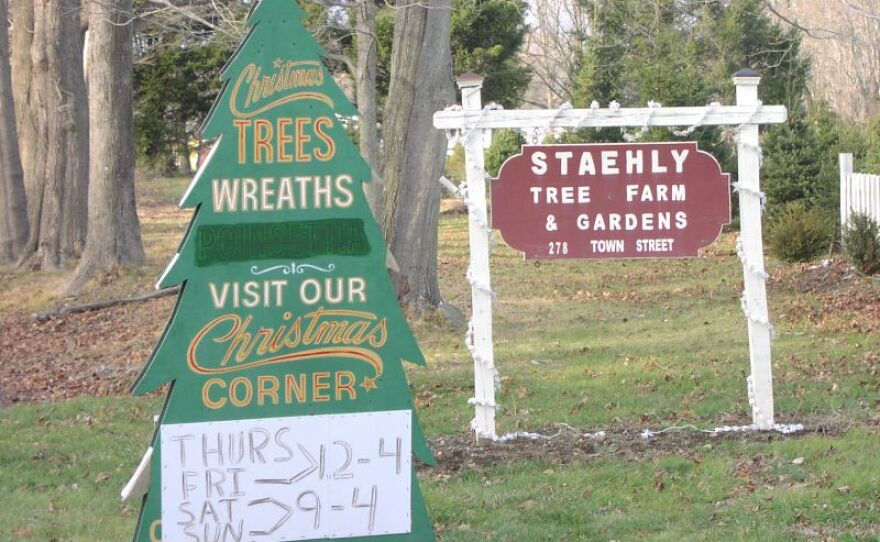
December’s a pretty intense month for many people – but imagine if you were a Christmas tree farmer. As this busy season comes to a close, WNPR’s Harriet Jones visited Staehly’s Tree Farm in East Haddam to find out what kind of a year this has been for the state’s tree growers.
“Hi there… how are you….”
Gail Staehly greets another customer who’s strapped a just-cut tree onto the roof of his car. Staehly and her husband Chris first began growing trees here in 1984 and sold their first Christmas tree in 1991. Chris Staehly says the business began almost by accident.
“Truth be told – I didn’t want to buy a Christmas tree. Actually when we started I said, I’m not going to cut the grass in front of the house here. I wanted to do something without cutting so much grass. I guess that was the wrong idea because there’s more grass to cut than you could ever believe here now.”
The Staehlys now have 14 acres devoted to Christmas trees – that’s about 17,000 individual trees of several different species. And lest you think they can just plant them and forget them….
“Nowadays, I would say 99 percent of the sales are for a shaped Christmas tree. There’s still a few people who want a natural looking tree with the extra branches or maybe a crooked looking tree, but they are the exception and not the rule.”
That means that Chris Staehly is walking his fields, shaping 17 thousand Christmas trees at the height of summer.
“We are out there starting with the pines in June. We have to actually sheer them by hand – every single tree. And we actually go around the tree and we cut off the crooked or the misshapen branches that are on there.”
In this business the weather is everything, and out in the windy tree lot, Staehly tells me this has been a pretty interesting year, between hurricanes and unseasonable snowfalls.
“But that’s the weather – you never know what you’re going to get. Also this year with all the rain, our one field on the side of our stand here, I mean people have had to wear boots to go out there to pick a tree. It’s never been that wet before.”
The best-selling tree is one between six and eight feet tall – that’s usually a ten-year investment for a tree farmer. And it also means the farmer has to guess, years ahead of time, which particular species of trees are going to be popular.
“The big thing now, people, I think they’re looking on the Internet, they want a tree that has longevity when they get it into the house. Seems to be the big one now is Fraser Fir – one of the more difficult to grow, unfortunately for us…..”
On this farm, trees are the mainstay, but on quiet days there are other Christmas activities supplement the season.
“We make a lot of our own wreaths still. We have a machine to wind them. The biggest thing about making a very nice decorated wreath is the consistency of the branches you’re cutting…..”
Back at the farm stand, Gail Staehly says selling 200 trees every weekend, December is a busy month, but a rewarding one.
“We have hot chocolate and we dip marshmallow in chocolate for the kids. We do reindeer food – we hand that out -- we’ve been doing that for years. So you know, we’ve had small children now coming back married. We’ve been doing it almost long enough where they’re coming back with their kids.”
While much of the rest of our holiday shopping may be migrating onto the Internet, the Staehlys and hundreds of other Connecticut Christmas tree growers will hope the lure of tradition keeps us all returning to the farm for years to come.
For WNPR, I'm Harriet Jones.


