
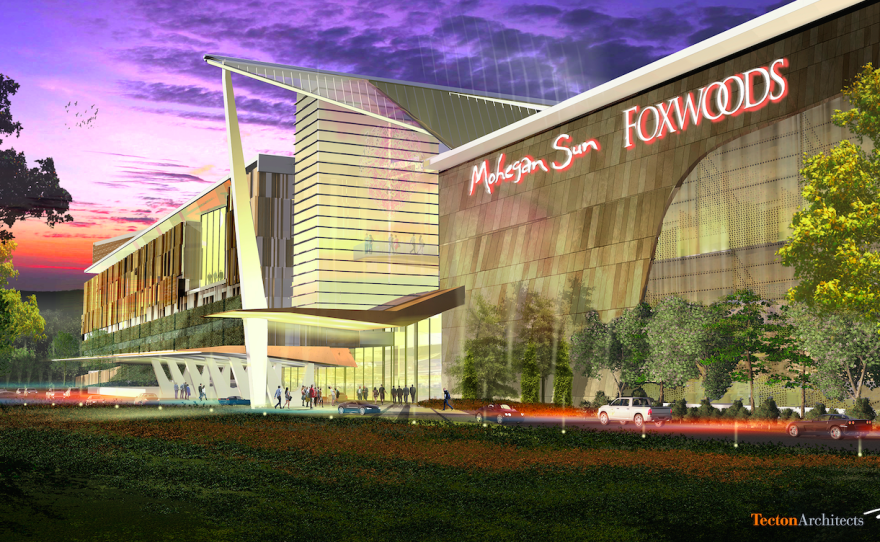

Governor Dannel Malloy has signed into law a measure that would allow the state’s two federally recognized tribes to build and run a third casino. But the legislation looks certain to attract legal action.
The casino is planned for the site of a shuttered cinema, off I-91 in East Windsor, and it’s designed to compete with a facility currently being built in Springfield, Massachusetts by MGM Resorts International.
MGM has threatened to sue Connecticut because the right to build the casino has been given directly to the tribes, rather than being awarded in an open bidding process.
Another piece of legislation before the General Assembly in the last session would have provided for a competitive process, but it failed to pass.
Mohegan Tribal Chairman Kevin Brown said the legal uncertainty won’t deter him from moving forward.
“There’s no question that MGM is going to try to attempt to make some sort of legal approach or litigation on this,” he told a news conference at the bill signing. “We have taken before steps to begin planning and constructing the facility under the shadow of litigation, and we’ll do it again.”
The tribes were strongly supported by labor organizations.
Andrea Goodrich, a casino worker and member of UAW Local 2121, said the tribal partnership has agreed with unions to provide living wage jobs with benefits as the expansion goes forward.
“Building this casino will allow Connecticut to remain competitive in the gaming market, protect both direct and indirect gaming jobs, create new jobs, and protect state revenue,” she said.
Governor Dannel Malloy said he sees the legislation as supporting employment in the state.
“This is worth fighting for, it’s worth protecting,” he said. “Quite frankly, it’s worth keeping Connecticut dollars being spent in Connecticut, as opposed to going up 91 and being spent someplace else. And I think that Connecticut residents will respond to that -- that they’ll understand the reinvestment in their own economy.”
The governor also said that he has signed amendments to the compacts that govern the tribes’ relationship with the state, allowing for the development of commercial gaming off of tribal land. Those amendments must now go before the legislature, and the federal Bureau of Indian Affairs will have 45 days to approve them formally, before construction can begin.
