
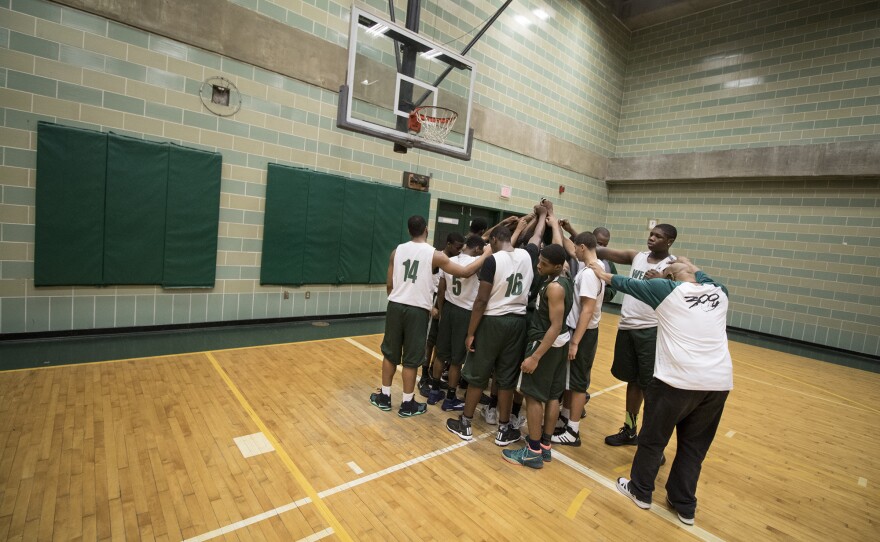
The Weaver Beavers have essentially played 22 away games this season.
Hartford’s Weaver High School varsity boys basketball team has been an underdog this season, in more ways than one.
Many of the team’s players come from difficult socioeconomic circumstances -- single-parent homes, living at or below the poverty line. Some of them view basketball as a path to college.
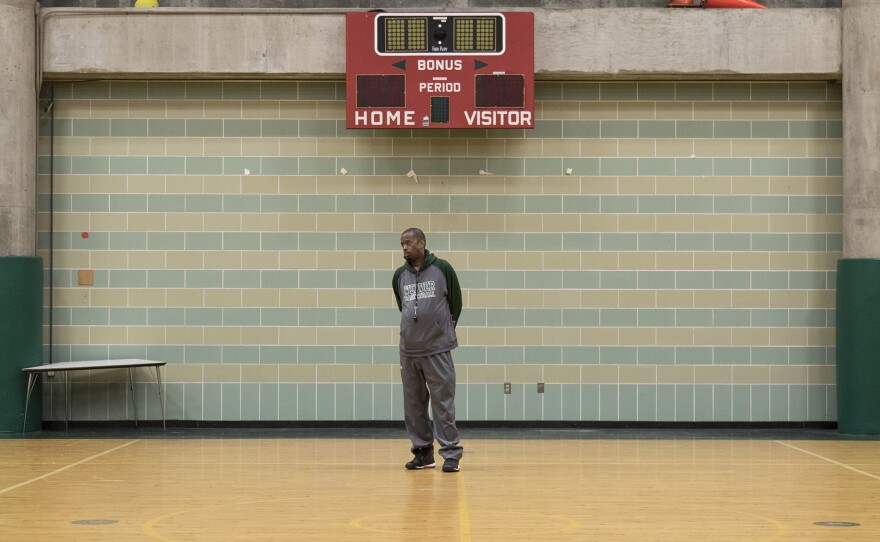
“A lot of the guys on our team, the only way they’re going to go to higher education is if they get an athletic scholarship,” the team’s coach, Reggie Hatchett, told WNPR’s Colin McEnroe.
From the outside looking in, Weaver -- one of the top high school teams in Connecticut -- appears to have the world at its feet. But the Beavers’ well-documented talent, skill, and track record of success mask an unusual hitch: Weaver has played its entire season without a home gym.
That’s because the school's Granby Street campus is undergoing a sweeping, $100-million renovation, forcing some of the school’s athletic teams to take up residence in Hartford's Culinary Arts Academy for the duration. The academy -- located within the city's Lincoln Culinary Institute -- houses one of Weaver’s academic programs, but is short on athletic facilities.
“I definitely use the fact that [the players] come from these areas where resources are so scarce,” Hatchett said on The Colin McEnroe Show. “And instead of using that to anger them and make them bitter, I try to turn that into fuel for them to use their sport to equalize the situation.”

The Beavers, led by Hatchett and star senior KeAndre Fair, are a No. 4 seed in the Connecticut Interscholastic Athletic Conference tournament, which starts this week. Weaver was last year’s champion in Class M -- the third tier of the state’s high school athletics pyramid -- and enters the tournament facing a stiff test in Class LL, a jump up from Class M.
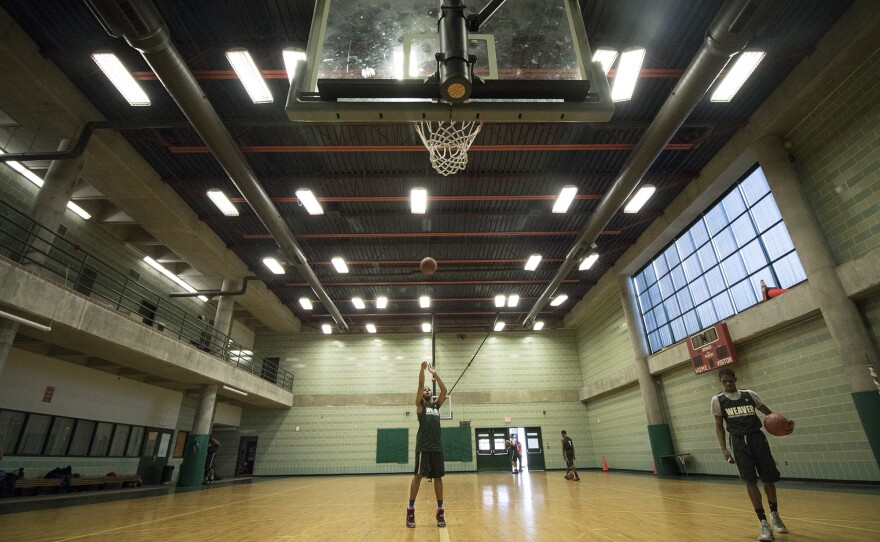
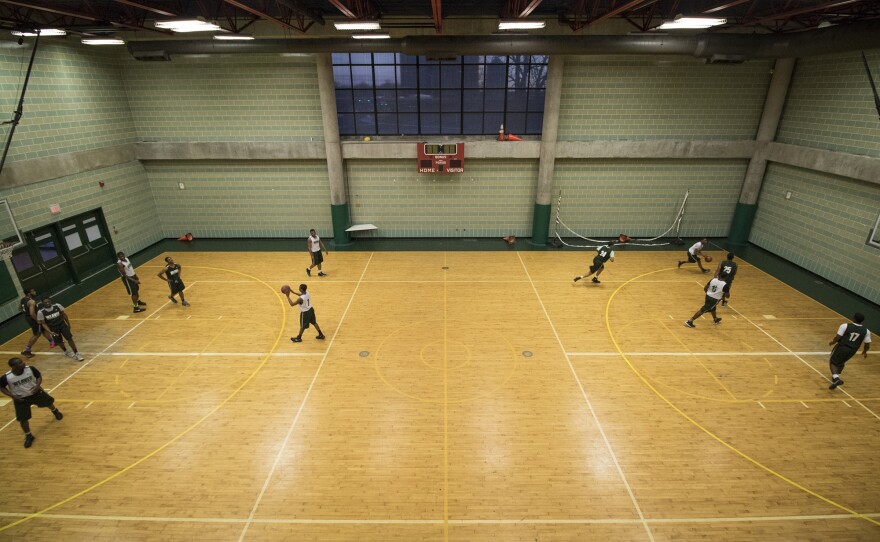
The situation has created a number of challenges for Weaver. The Culinary Arts Academy's court that the team practices on is smaller than regulation size, and only has two baskets. They play their “home” games at Classical Magnet High School, about a 10-minute drive away.
“The gym is smaller, and also when it rains, the ceiling leaks, and we can’t go up and down [the court] because it’s dangerous for the kids to be on parts of the floor where there’s water,” Hatchett said. “And it’s been raining and snowing a lot this winter.”


When leaking water becomes an issue, the team resorts to using bright orange traffic cones to mark which areas of the floor to avoid.
“It got ugly in here a couple times,” Fair said, speaking after a practice last week.
Because of the Culinary Arts Academy gym’s size, the team can’t accurately practice full-court drills, nor can players create a representative mental picture of the floor. These things are critical in basketball -- a game of spacing, interplay, and efficient movement.
It even affects fitness, with players covering less ground during practice than they would in a full-size facility.
“The gym has definitely affected our outcome, because you can’t really practice spacing or full-court traps or certain things like that because, when you work on these things, you make mental notes based on where you’re supposed to be based on the imaging on the court,” Hatchett said.

Despite being a team without a true home, Weaver hasn't let up.
Sterling Scanlon, Weaver’s athletic director, said the gym conundrum has contributed to the pile of problems that are often unique to inner-city schools.
Some suburban schools don't understand what Weaver's student athletes go through, Scanlon said.
“Just to even get to practice, just to get home, just to get here to play their games, not at home. It’s tough, but it’s the situation that we’re in," he said. "So they kind of have to deal with it, which is unfortunate.”
Despite being a team without a true home, Weaver hasn’t let up. Hatchett’s squad finished the regular season with 19 wins against just three losses. Fair, whom The Hartford Courantnamed the best player in the state last year, continues to play a critical role as a captain and senior on an otherwise young team.
“Just being the oldest guy, the vet, the more experienced one, leading these guys everyday. They’re watching [the seniors], because one day that’ll be them,” Fair said. “That’s probably the most exciting thing, especially in the games. Say we make a good play, a crunch-time play. Just them on the side cheering us on, that always gets me excited.”
Whether Weaver captures a second-straight state title or not, the team can finish the season knowing it made the best of a less-than-ideal situation. And there’s also a light at the end of the tunnel: $20 million of the $100 million in reconstruction funding has been set aside for athletic facilities, with $5 million going toward fixing Weaver’s Doc Hurley Field House.
“I think our kids are very resilient,” Scanlon said. “I think that, unfortunately, they’ve been through a lot in their own lives that they see this as just another hurdle to their goal. I think our kids, both the boys and girls program, really do well on how they present themselves on the court and off the court. So things like this, I’m sure it frustrates them, but it kind of just adds fuel to their fire a little bit.”
Jackson Mitchell is an intern at WNPR. An earlier version of this story included a quote that named specific towns in relation to Weaver's athletic program.



