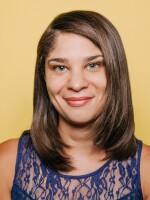
Valzhyna Mort started playing accordion when she was six. She took it seriously.
"I played it for a good 10 years," she says, "practicing daily under my grandmother's very strict watch."
And when she was a teenager, in her native Belarus, she started to look for music in language. She became a poet; her new book is Music for the Dead and Resurrected, and one of the poems that caught my eye is called "Music Practice."
Mort reads: "Should I go ahead and profess / that in the name / of that man who played any instrument thrown at him / — a cimbalom, a mandolin, a fiddle — / but ended up quickly killable / once thrown into a war / (not even a Great one at that) / I was drafted into music."
It's about her great-grandfather. Her grandma used to tell her stories about him.
"He died young, drafted into a Polish Soviet war for the Western territories in Belarus," Mort says. "He was not much of a soldier. He was a farmer. But he also really loved music. He made these instruments himself, and played them and sang. And so the only thing pretty much of what my grandmother remembered about her father was him singing to her, was him playing these handmade instruments. And it turned into a bit of an obsession, because that was the only way to remember him."
"There are these official historical narratives. But there is also a way of remembering through feeling emotional history — not how it was, but how it felt. And we could say that, well, you know, we all live and die and we remember them, the names of generals, the numbers. And we are all so temporary here. But I think this is the duty of a poet, but also here as heir to a family history to see eternal meaning in these temporary events."
Interview Highlights
On writing a powerful poem about a man she never met
Only when I sing as a poet, I'm able to leave my human body, leave myself and approach that ultimate other, who for me are my dead, my ancestors.
When we listen to a great poem, we cannot really paraphrase it. It seems like nothing was said to us really, yet everything was said to us. And music is particularly important to me, not only because it is a blueprint of a soul, but also because music allows our polyphony. I listen to polyphonic works when I write poetry, when one voice makes space for other voices. Only when I sing as a poet, I'm able to leave my human body, leave myself and approach that ultimate other, who for me are my dead, my ancestors. So I want to become that kind of a human transmitter, so that as I search through different intonations, different pitches, I can hear something because I'm living right now on Earth, and people whom I'm addressing are not.
On talking to ancestors as part of Belarusian culture
It is part of Belarusian culture, but also I think it is a part of Belarusian history of violence and history of terror. On the one hand in our pagan traditions, there is a cult of the dead and the honoring of the dead. But there is also something that is just from the past hundred years of living through a history of violence, terror and silence, when most people in Belarus do not know much about the families that they come from.
And this book, Music for the Dead and Resurrected, is a book about the legacy of violent deaths in a family, is about not knowing your ancestors. Their deaths fell into a kind of archive of silence. You know, one third of my life was spent with my grandmother, who was my survivor, and in Belarus all survivors — we're all born only because there was one survivor in our family, often it was a woman, a storyteller.
And so my grandma would sit me in the kitchen every day after school and tell me the whole story of her life. The Stalinist '30s, World War II, living in Soviet Belarus after the World War II — and World War II was devastating for Belarussians. And so I heard the stories daily, but then I was angry and sad in history classes, in literature classes, because the stories of my family, of my dead had no place in official historical narratives.
On the transformative power of love
And this is a big transformation that is happening with me in this book, the recognition of love as the power to transform violence, to transform broken hearts, to transform family.
It is something that today, as our uprising is happening in Belarus, a lot of people are talking about that that are all children brought up by mothers who did not receive enough love from their mothers and so on and so forth. Why did it happen? Well, because they were orphaned. They were orphaned by war, families were broken up. And we were brought up not to trust anybody. We were brought up to look up to a bully, to see strength in violence rather than in kindness.
And this is a big transformation that is happening with me in this book, the recognition of love as the power to transform violence, to transform broken hearts, to transform family. Once we love ourselves, once we trust in the transformative power of this love, this is how we stop being selfish, and when we become ready to share stories and to hear stories that are not only ours.
This story was edited for air by Jeevika Verma and Reena Advani, and adapted for the Web by Jeevika Verma and Petra Mayer.
Copyright 2021 NPR. To see more, visit https://www.npr.org.